.svg)

The 69% Difference Between Good and Great Salespeople, According to New Data



10 years ago, I led the first research study of its kind while at Gong.
We analyzed 25,000 recorded sales calls using AI so we could answer:
What separates great salespeople from everyone else, according to data?
Our first finding?
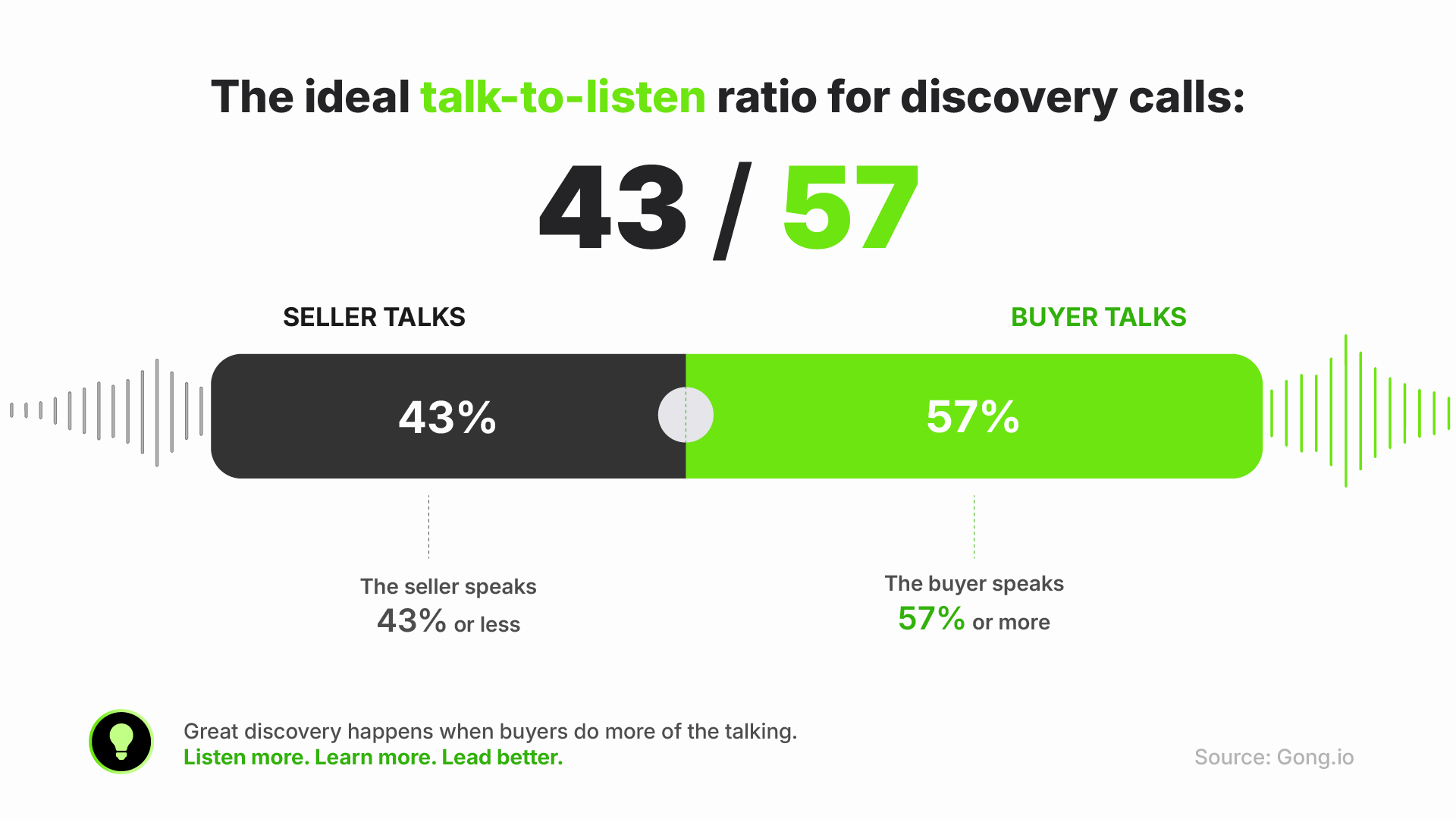
We discovered that the ideal “talk-to-listen ratio” for discovery calls was 43/57.
In other words:
The seller speaks 43% of the call or less while the buyer speaks 57% or more.
When we published it, it went viral.
And people still reference it 10 years later.
But there was one problem with it:
It didn’t explain how or why:
Why do buyers “open up” to great sellers and keep others at arms-length?
In a world of buyers afflicted with “discovery fatigue,” it’s not as easy as it sounds.
- Is it how many questions great salespeople ask?
- The quality of their questions?
- How they follow up with questions?
- Something else?
Back in 2016, no one had an answer.
Today, 10 years later, we do.
In this post, we’re going to answer that with data:
We analyzed the skills of 1,592 sellers across over 300,000 calls using AI.
According to that data, great salespeople are 69% better at one skill.
Great salespeople are 69% better than others at one underrated skill.
How do great salespeople get their buyers talking and opening up… a lot?
They are masters at one seemingly minor skill:
“Strategic synthesis.”
What does that mean?
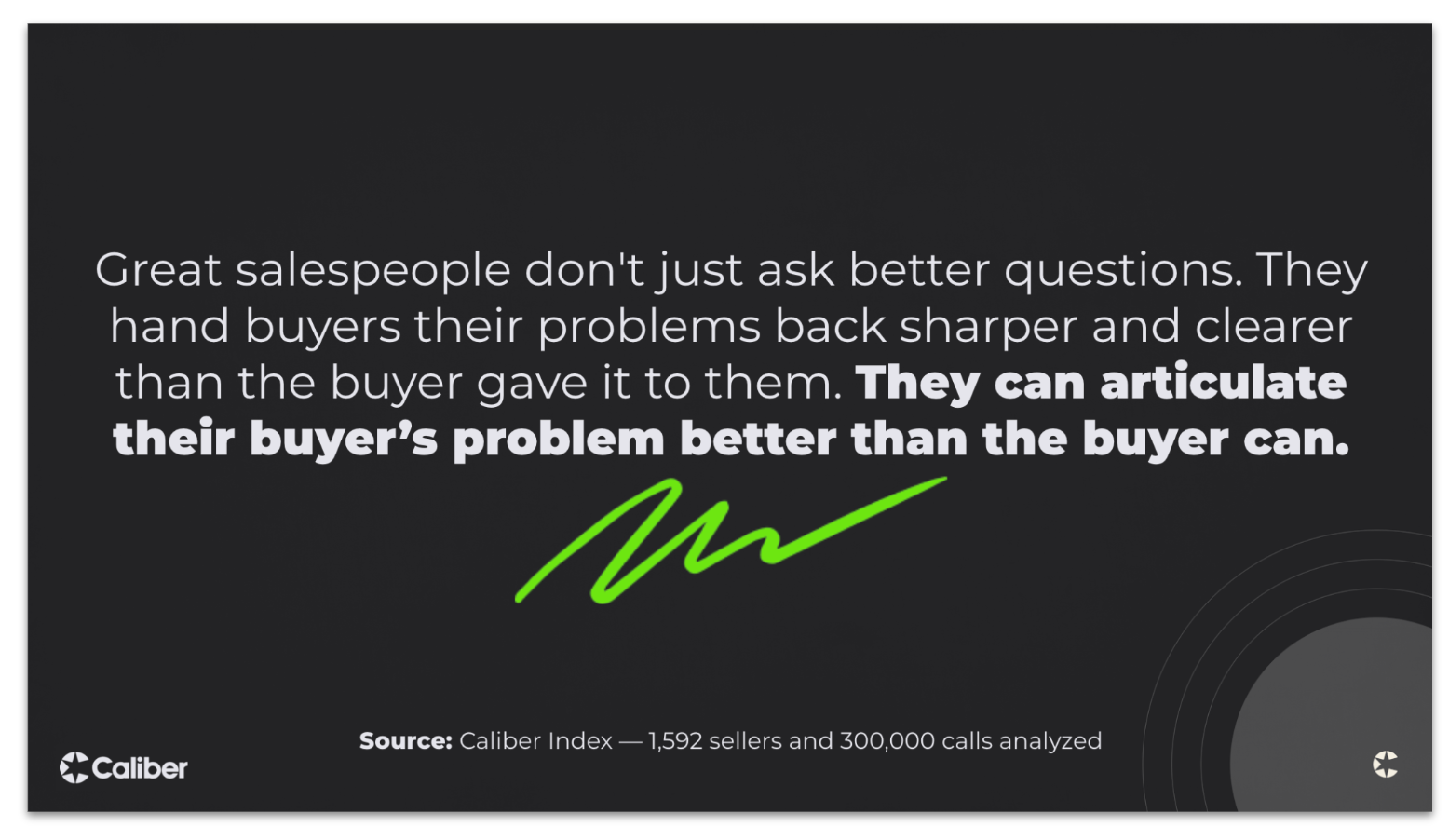
Great salespeople don't just ask better questions.
They hand buyers their problems back sharper and clearer than the buyer gave it to them.
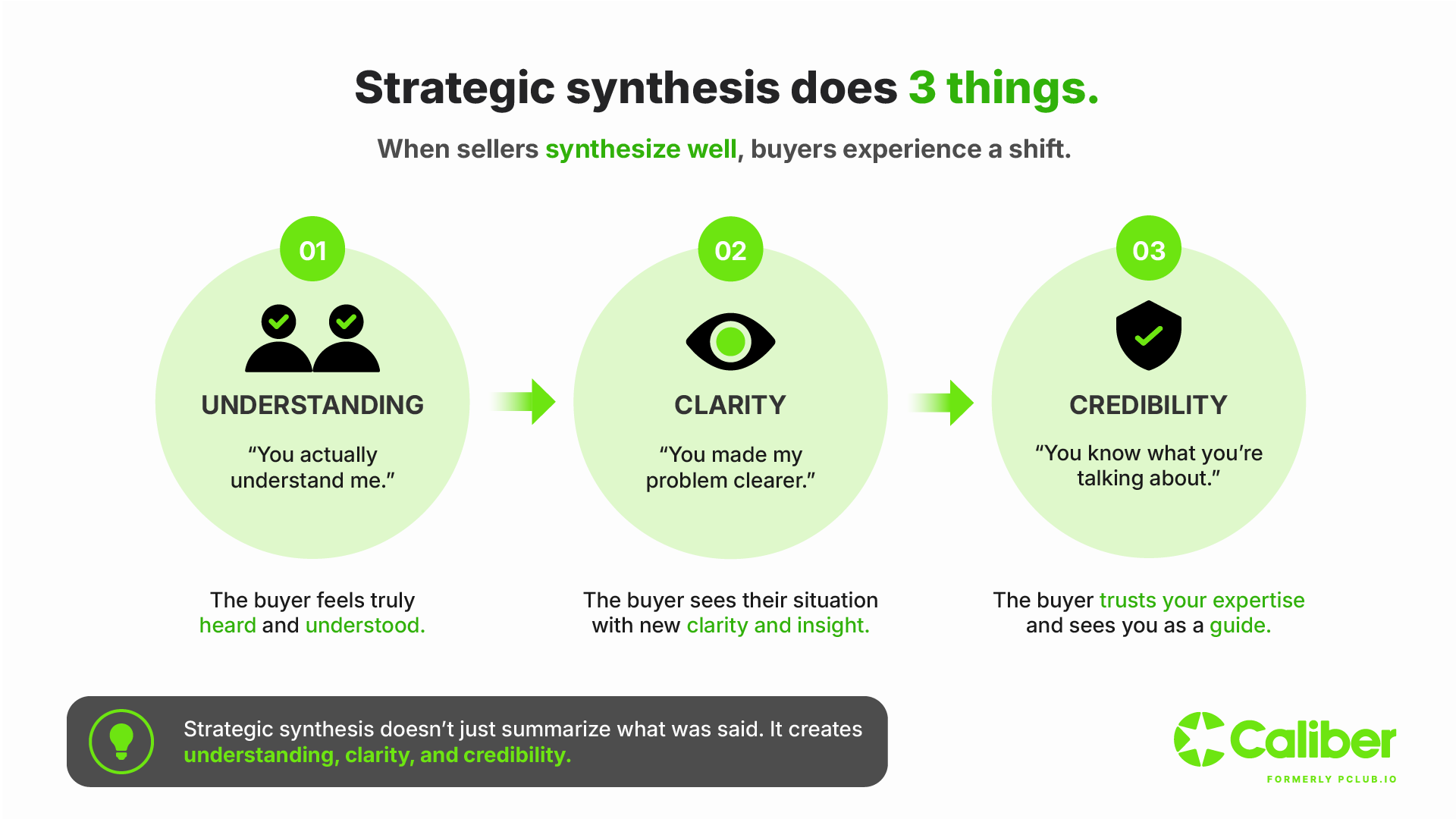
In other words, they synthesize and summarize what the buyer is saying back to them in a way that does three things:
- Makes the buyer feel deeply understood.
- Clarifies the buyer’s problem in a way they couldn’t.
- Demonstrates the seller’s credibility and expertise.
They don’t just parrot things back word for word.
They synthesize.
Great salespeople can articulate their buyer’s problem better than the buyer can.
As a result, they help the buyer crystallize their thinking.
Think of it as rocket-fuel for trust building.
And it compels buyers to respond in ways that sound like this:
“Yes… That’s exactly what I was trying to say. And also…”
Here’s what the data says
Where did this insight come from?
A first-of-its-kind AI data analysis.
This is not the typical analysis of sales conversations that stops at basic stats
(like the talk-to-listen ratio).
In this data, we are talking about which skills are most strongly associated with certain outcomes, now that AI is smart enough to define, identify, and measure sellers skills.
We analyzed the skills of 1,592 sellers and 300,000 of their calls using AI.
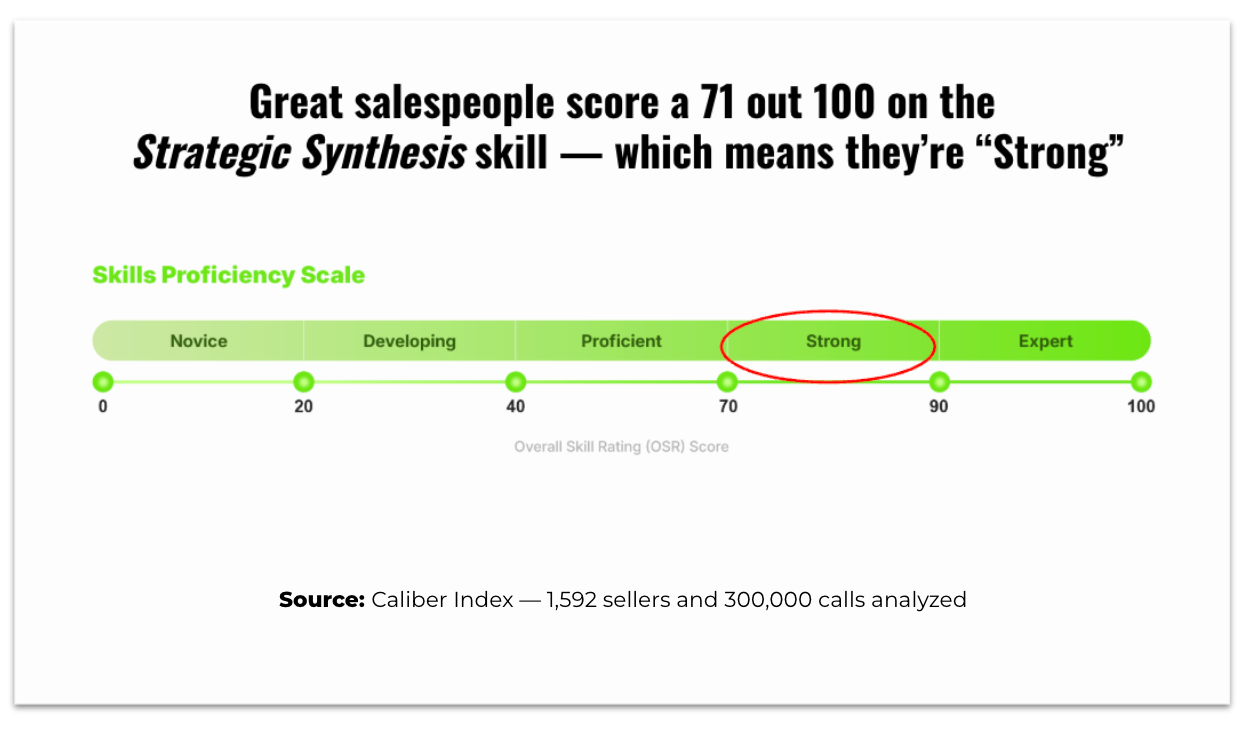
Over 36 skills were scored against a standardized skill scoring model that looks like this:
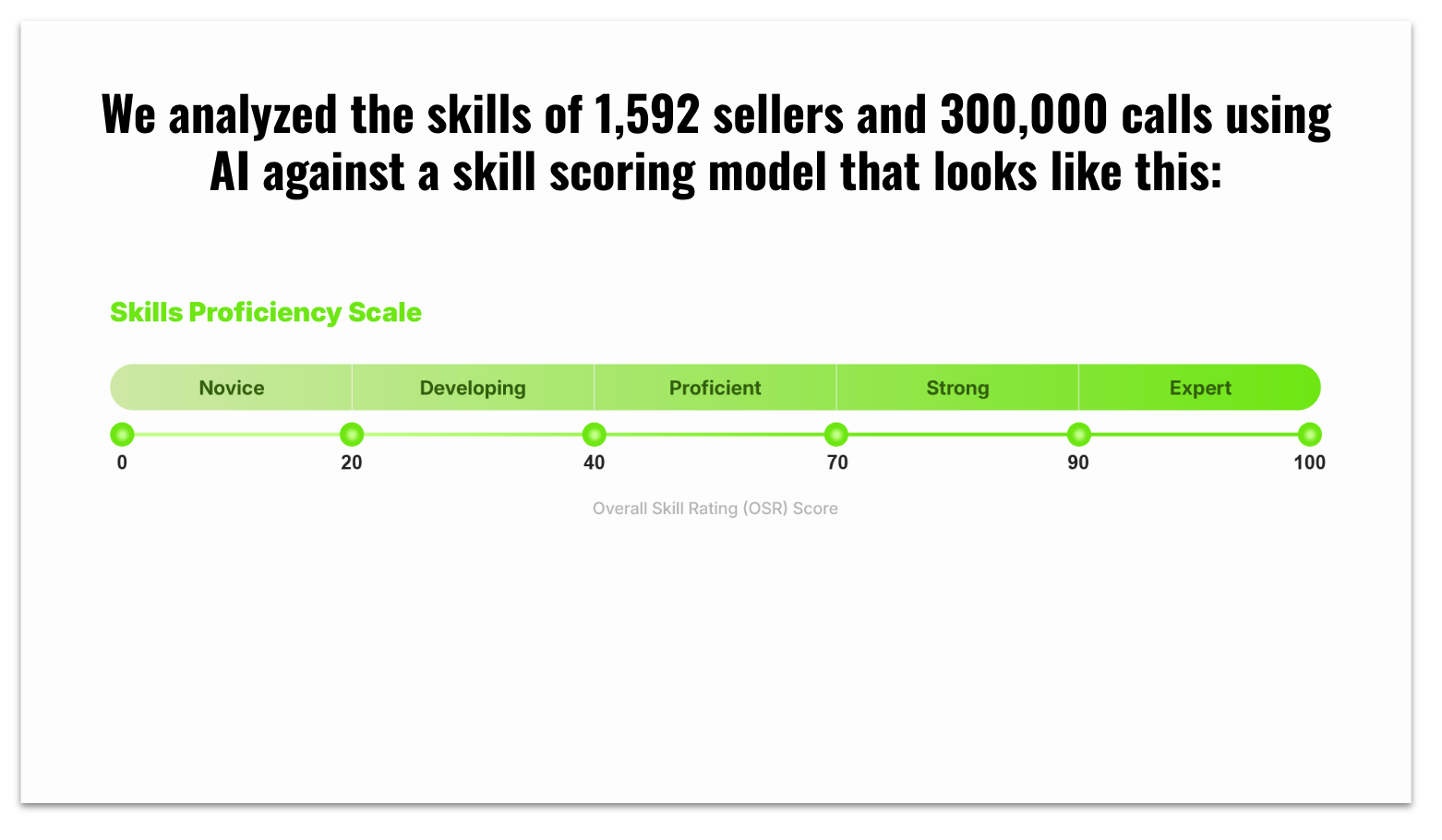
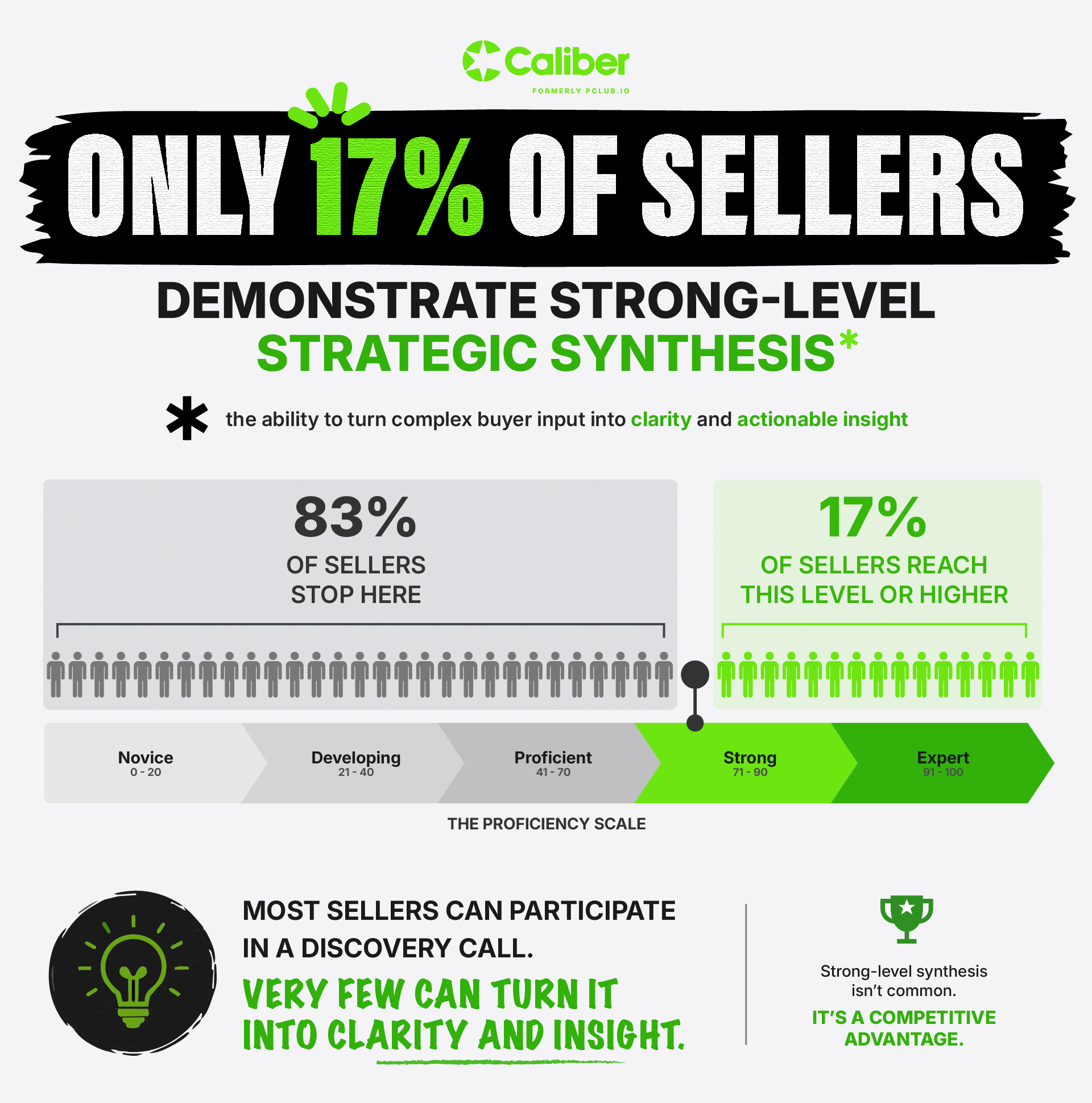
The model scores skills on a scale of 0–100 and spans five skill levels:
- Novice (no skill)
- Developing (weak skill)
- Proficient (skill exists, but inconsistent)
- Strong (consistent skill demonstrated)
- Expert (mastery of the skill)
Then we sought to answer:
“What skills do great salespeople have that others don’t?”
Let’s break down the data, step by step
First, we grouped the sellers in the study into three groups:
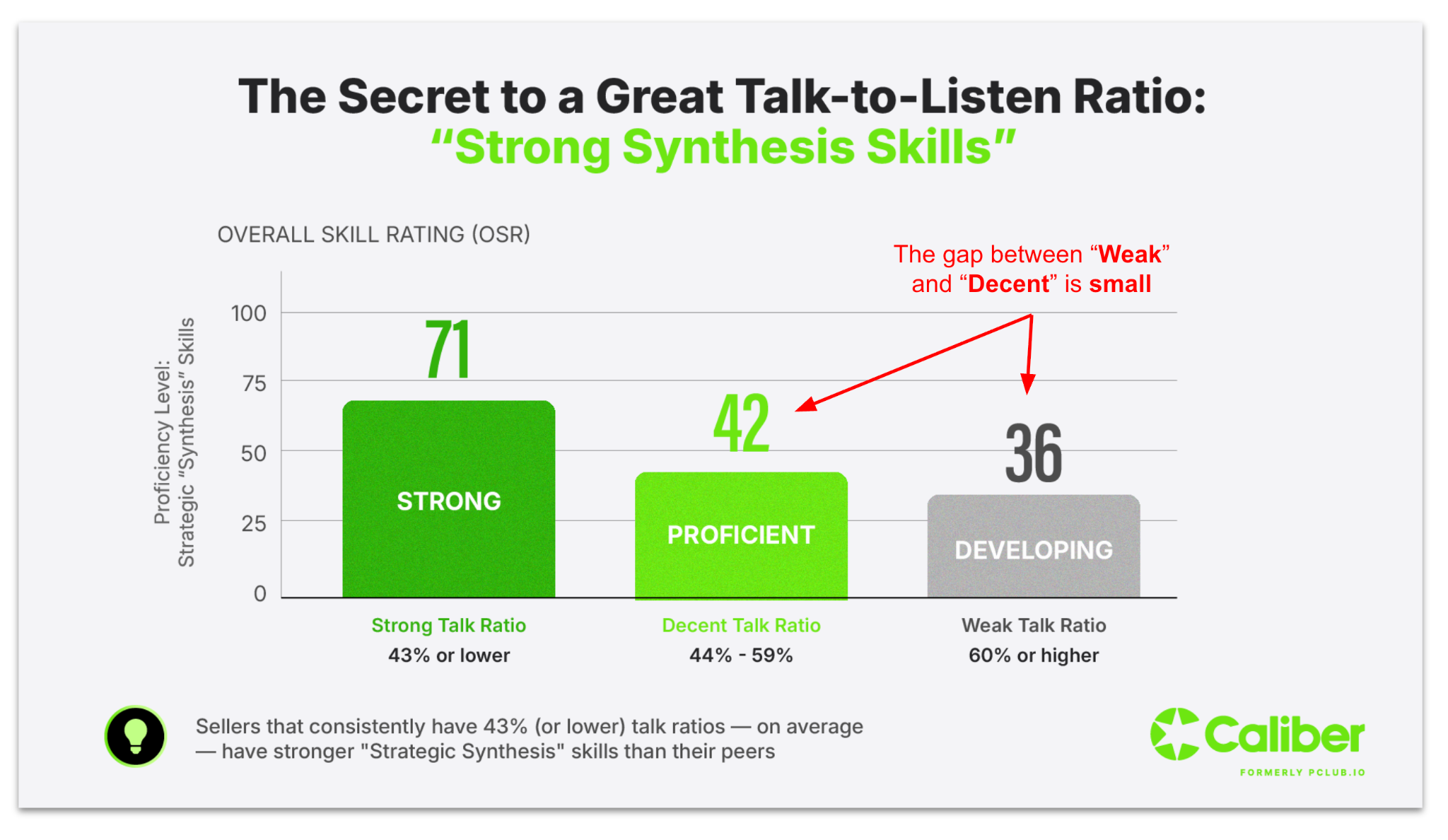
- Those with strong talk ratios.
- Those with decent talk ratios.
- Those with weak talk ratios.
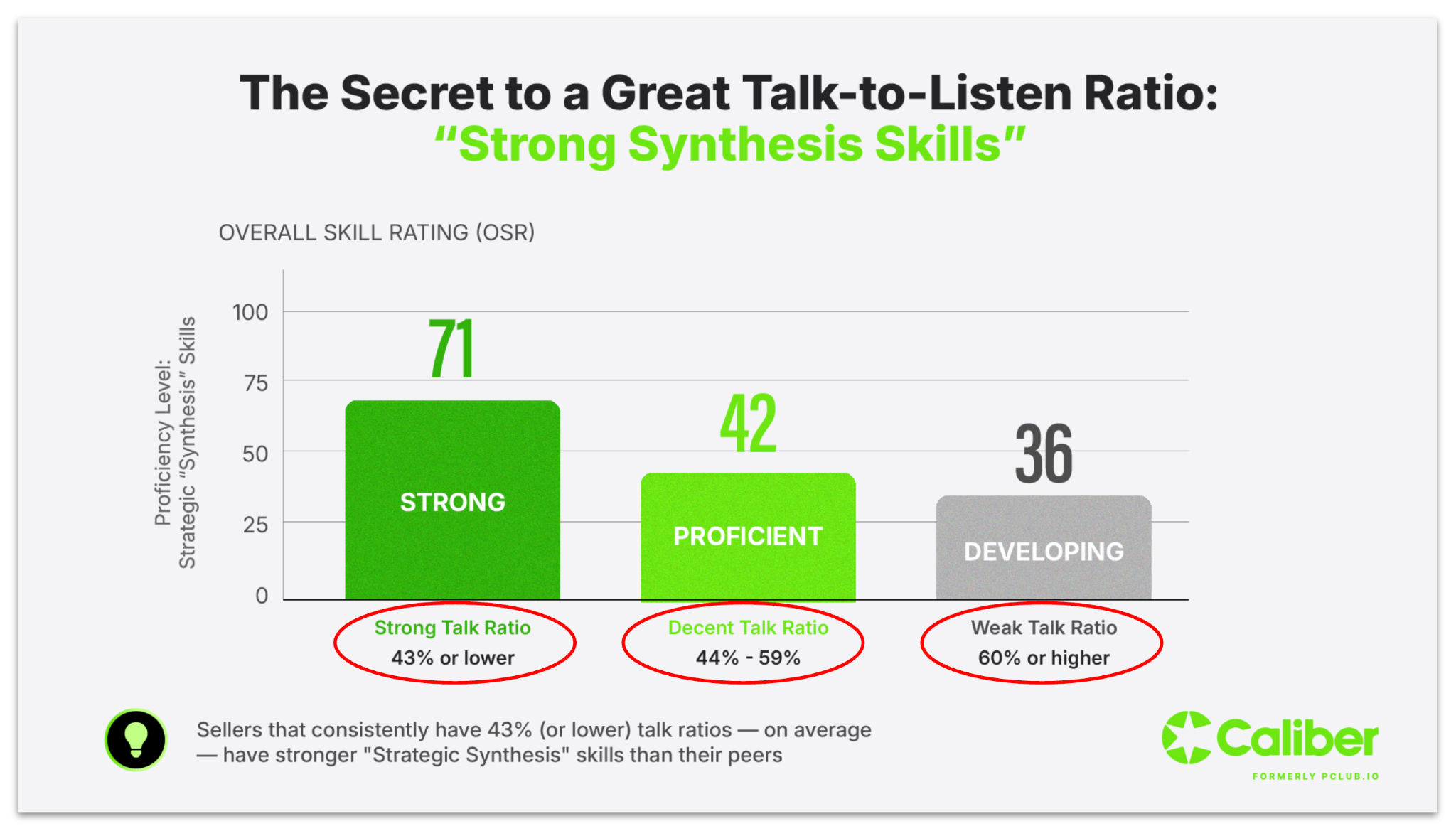
Then we scored their skills on the standardized skill scoring model from 0–100.
As it turns out:
There was one skill in our model that salespeople with strong talk ratios had in far higher quantities than everyone else:
And that skill was Strategic Synthesis.
Great sellers averaged a 71 out of 100 on this skill.
For context, that is a “Strong” score in our model.
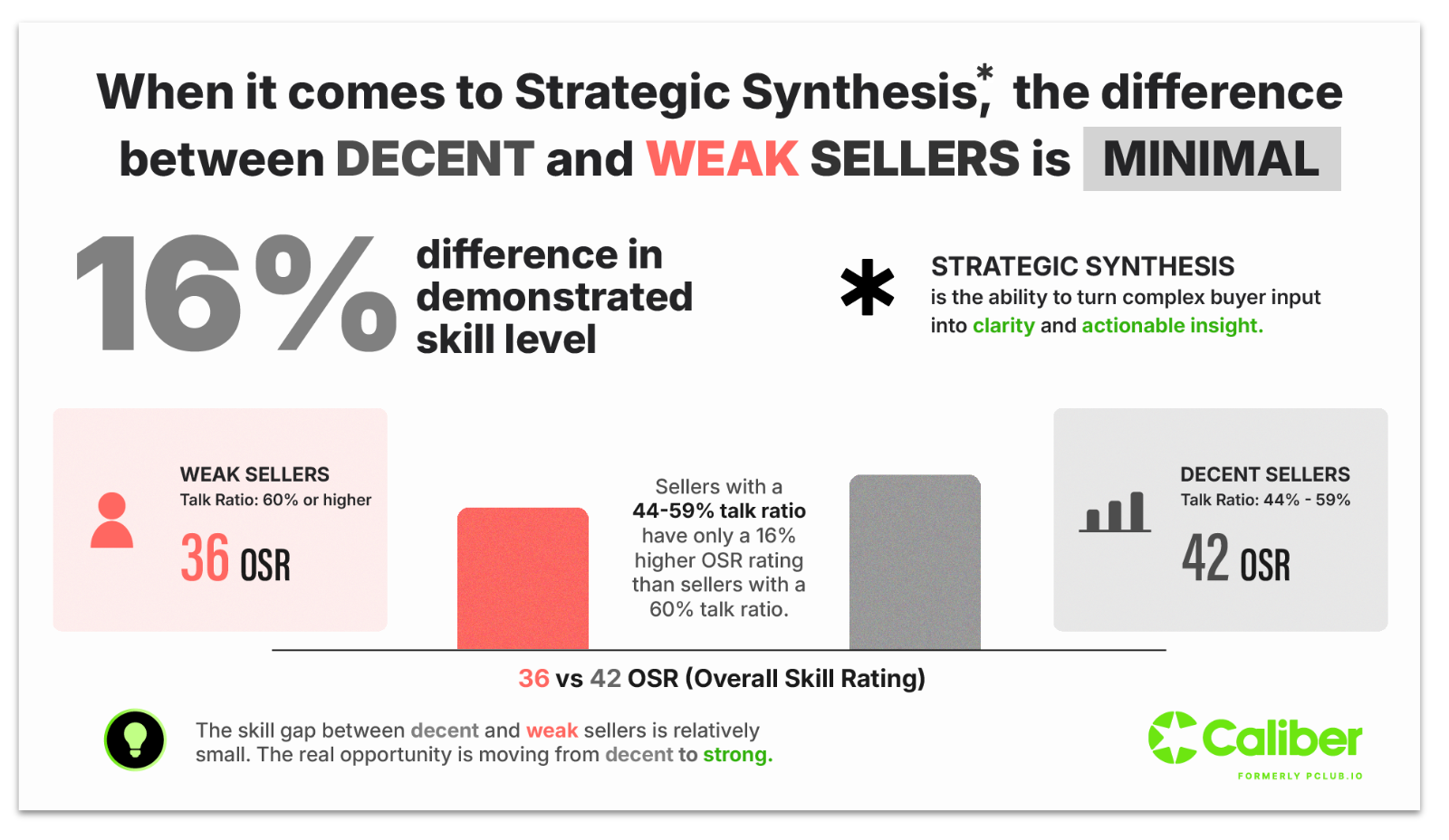
Decent sellers averaged only 42 out of 100.
And weaker sellers scored only 36 out of 100.
Great Salespeople Are 69% Better at Strategic Synthesis
Take a look at the chart again,
The difference between weak and decent is negligible.
They are basically in the same ballpark.
But…
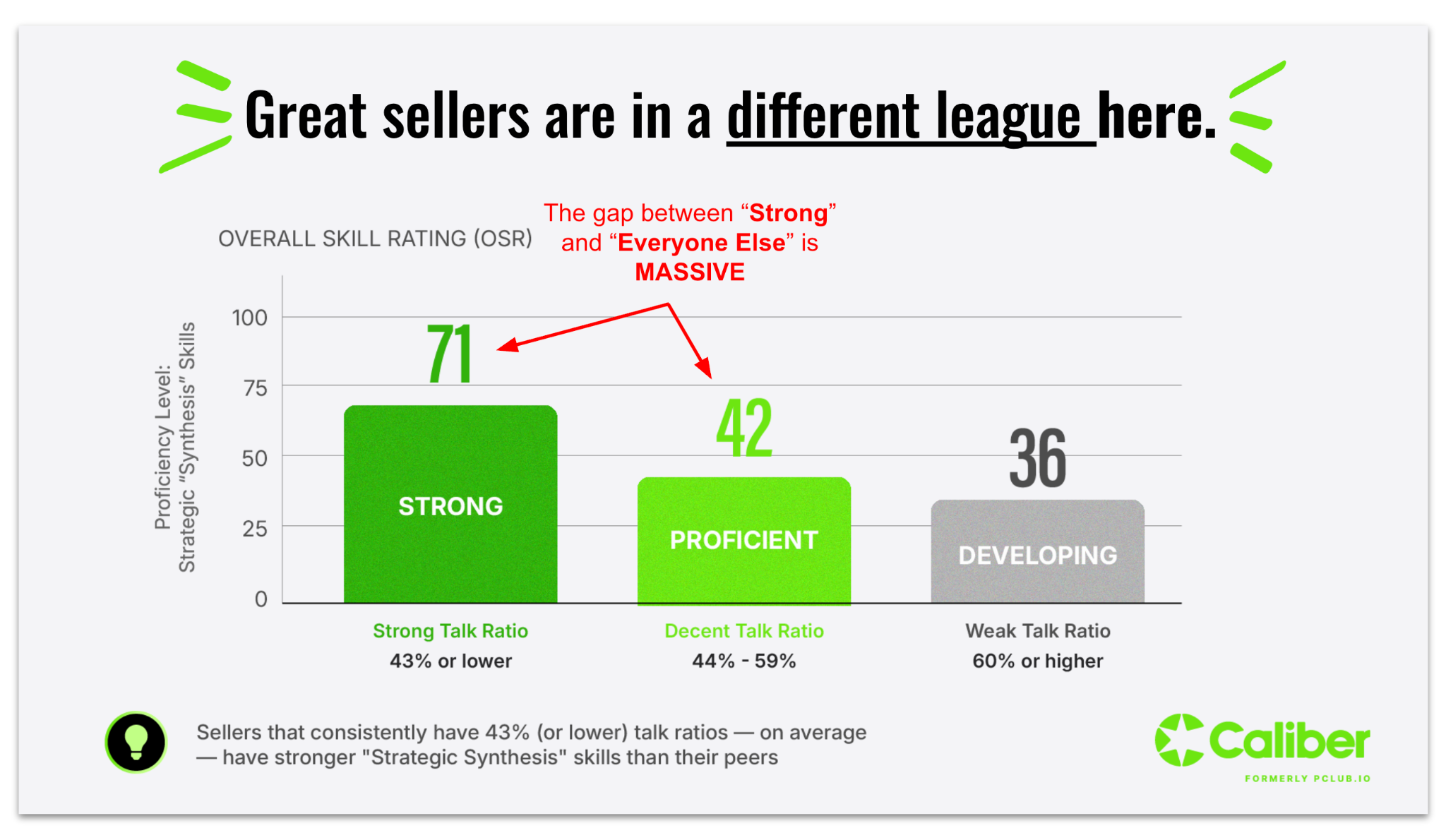
The gap between strong sellers and everyone else is massive.
As in:
Great sellers are in a different league.
They are a whopping 69% better than their peers.
That’s almost double.
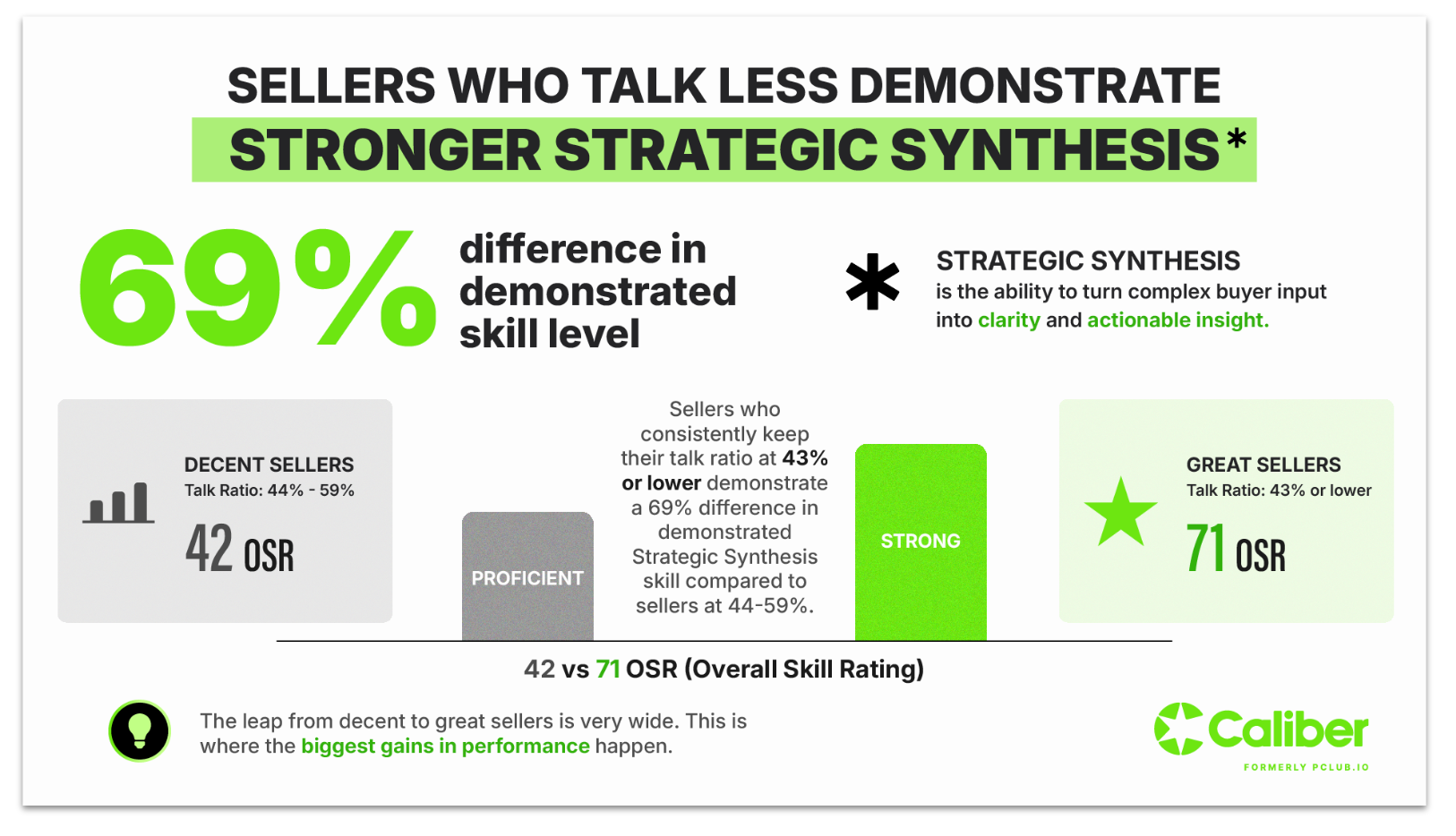
And yet the difference between “decent” and “weak” is minimal:
Only a 16% difference.
Why?
At the time of this writing, we can only speculate.
But here’s our theory:
The difference between weak and decent has more to do with basic differences:
Asking the right questions, and shutting up.
But the difference between decent and great is more nuanced.
After all, “strategic synthesis” is not an easy skill to master.
You have to be sharp.
Clarity and Insight, Not Just Summarizing
Imagine you’re a modern buyer.
You’ve been on many “discovery calls” with salespeople.
Most of them: pretty bad.
You get on yet another one.
And the seller starts with a few questions to get the ball rolling.
Nothing unique here so far (*sigh*).
But after you share the gist of your challenges, this seller does something different.
They say something like:
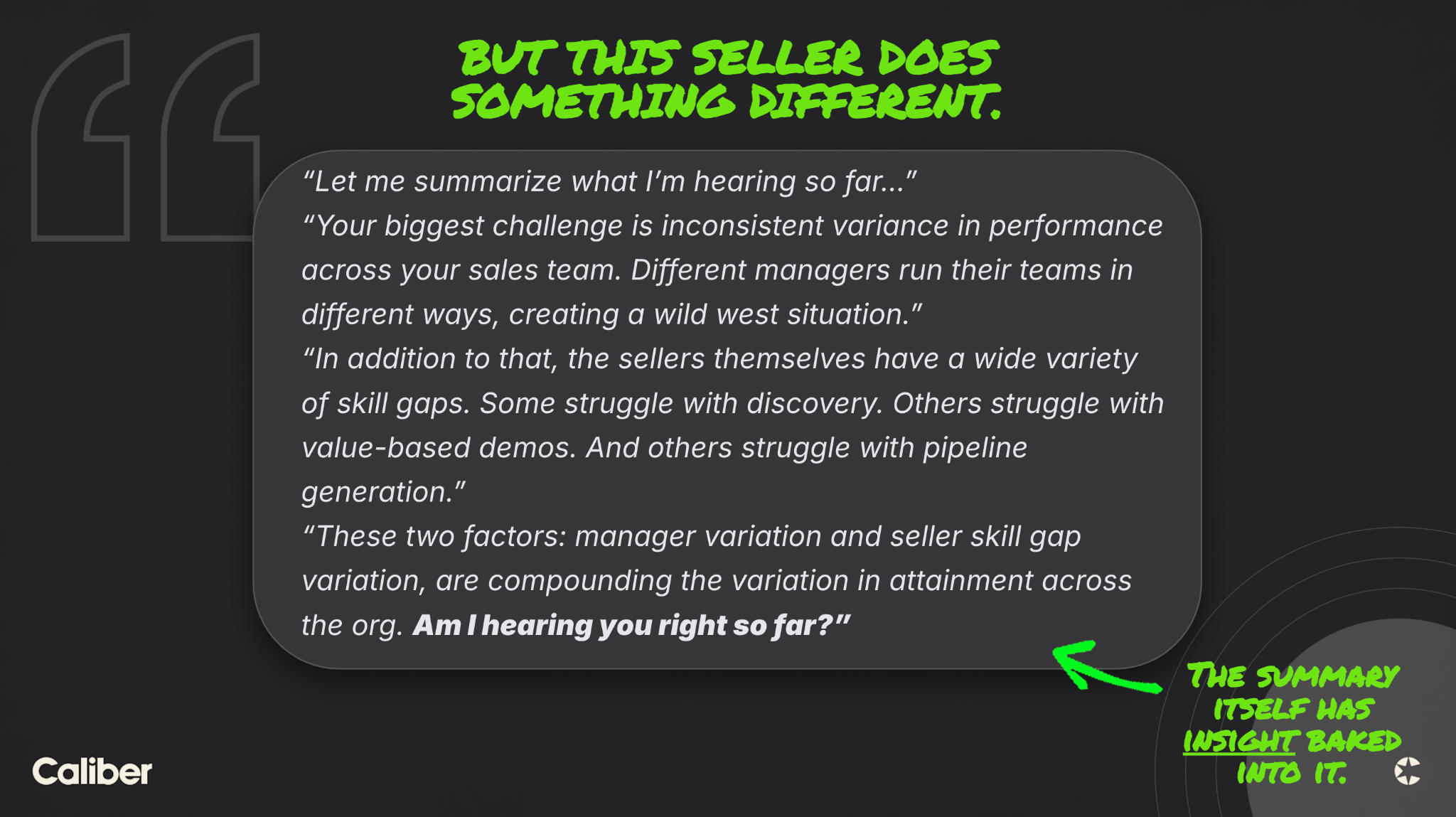
Pause and notice something.
It doesn’t just summarize exactly what the buyer said.
The summary itself actually has insight baked into it.
The seller handed the buyer their own problem back, sharper and clearer.
They articulated the buyer’s problem better than they articulated it themselves.
That’s much harder to do than just parroting something back, word for word.
It’s not “just” a summary.
It’s a synthesis.
The seller turns messy buyer answers into clarity and insight.
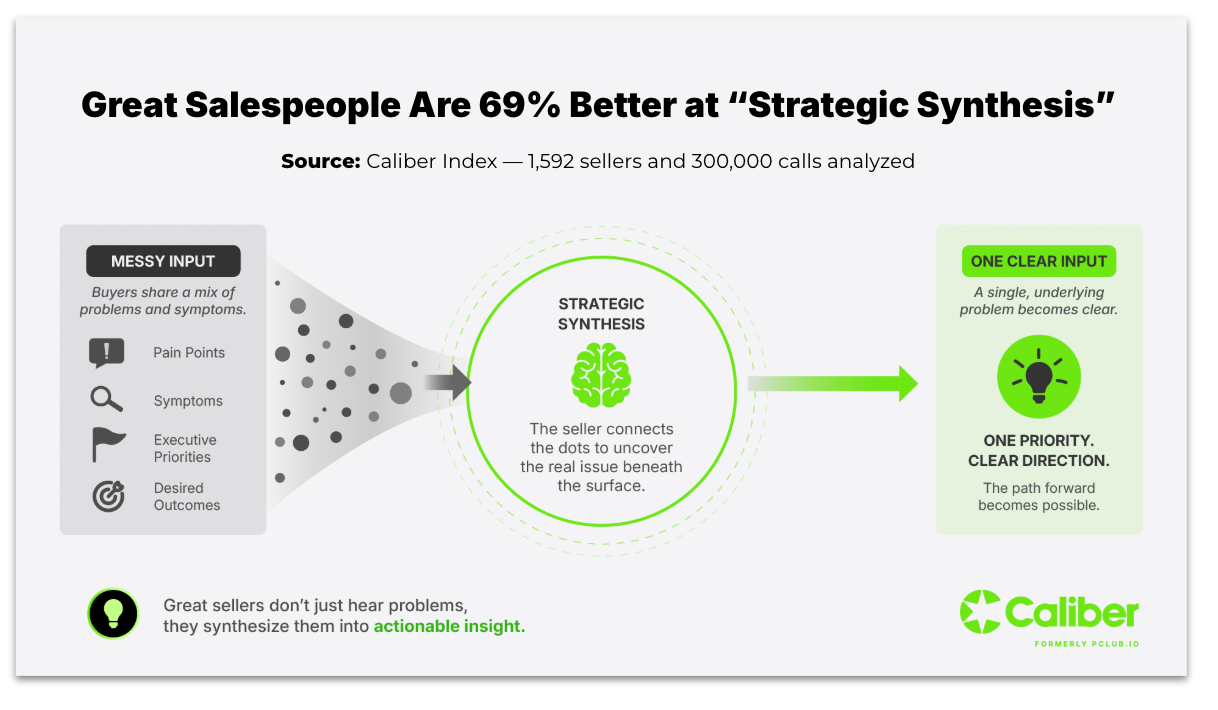
When a buyer sits back and listens to it, it may give them an epiphany.
And they respond with something like:
“Yes… that is exactly what’s happening. And also…”
… And off they go sharing even more.
An effective “synthesis” says something about the seller:
1. I’m listening and understand where you’re coming from
2. I know what I’m talking about because I see this a lot.
When sellers do this right, buyers feel compelled to share even more.
Why do buyers respond like this?
Because this seller just proved that this conversation is time well-invested for them.
The buyer no longer sees them as a salesperson or vendor.
They see them as a guide or advisor.
If you do this well, you’re in rare company
Most salespeople do not do this at all – let alone do it well.
That’s not an opinion. That’s what the data says.
Only 17% of sellers do this well:
And that’s your opportunity.
That means Strategic Synthesis isn't table stakes.
It's a separator.
Which means learning to do this well puts you in rare company.
A 10 year old question, answered.
Ten years ago, we discovered the 43/57 rule.
It told us what great discovery conversations looked like.
This data gives us our first clue as to how.
Great sellers don't merely ask questions and listen.
They turn what they hear into clarity.
They hand the buyer their own problem back—sharper and clearer than the buyer gave it to them.
We call that Strategic Synthesis.
And only 17% of sellers in our dataset demonstrated it at a Strong level or higher.
That's a learnable skill.
If you liked this data, you can expect more from us.
This is Issue 001 of The Caliber Index.
We’ll be publishing more research like this as often as we find new discoveries.
Please share this with your team (or other salespeople you know).
A rising tide lifts all boats.
Thanks for reading.
Going further: How to learn what great salespeople do
If you want to master this skill, I’m inviting you to the Questions That Sell Summit, free.
You’ll learn a powerful yet easy-to-follow framework to “synthesize” complex customer conversations.
Just like great salespeople do.
You’ll learn how to articulate your buyer’s problem better than they can.
No mindreading needed. It turns out, when you have a solid framework, it’s pretty easy.
Think of today’s post as teaching you what great salespeople do.
But in this free event, I’m going to teach you how to do what they do.
And then we’re going to build on that and learn three advanced forms of questions that sell.
Not the basics.
Advanced.
The kinds that separate great salespeople from everyone else.
Because if you can’t ask great questions that sell?
You won’t have a chance to use your synthesis skills to begin with.
The event is free to join, and you can register here:
>> Join the Questions That Sell Summit.
If you can’t make it, register anyway. I’ll send the recording this time.
Hope to see you there.
And once again, if you liked this post:
Share it with your friends.
That would be incredible.
Chris Orlob,
CEO, Caliber
P.S. Here’s the slide deck that has all of the key visuals and charts from this research, in case you’d like to use them in any way, which you’re free to do.